
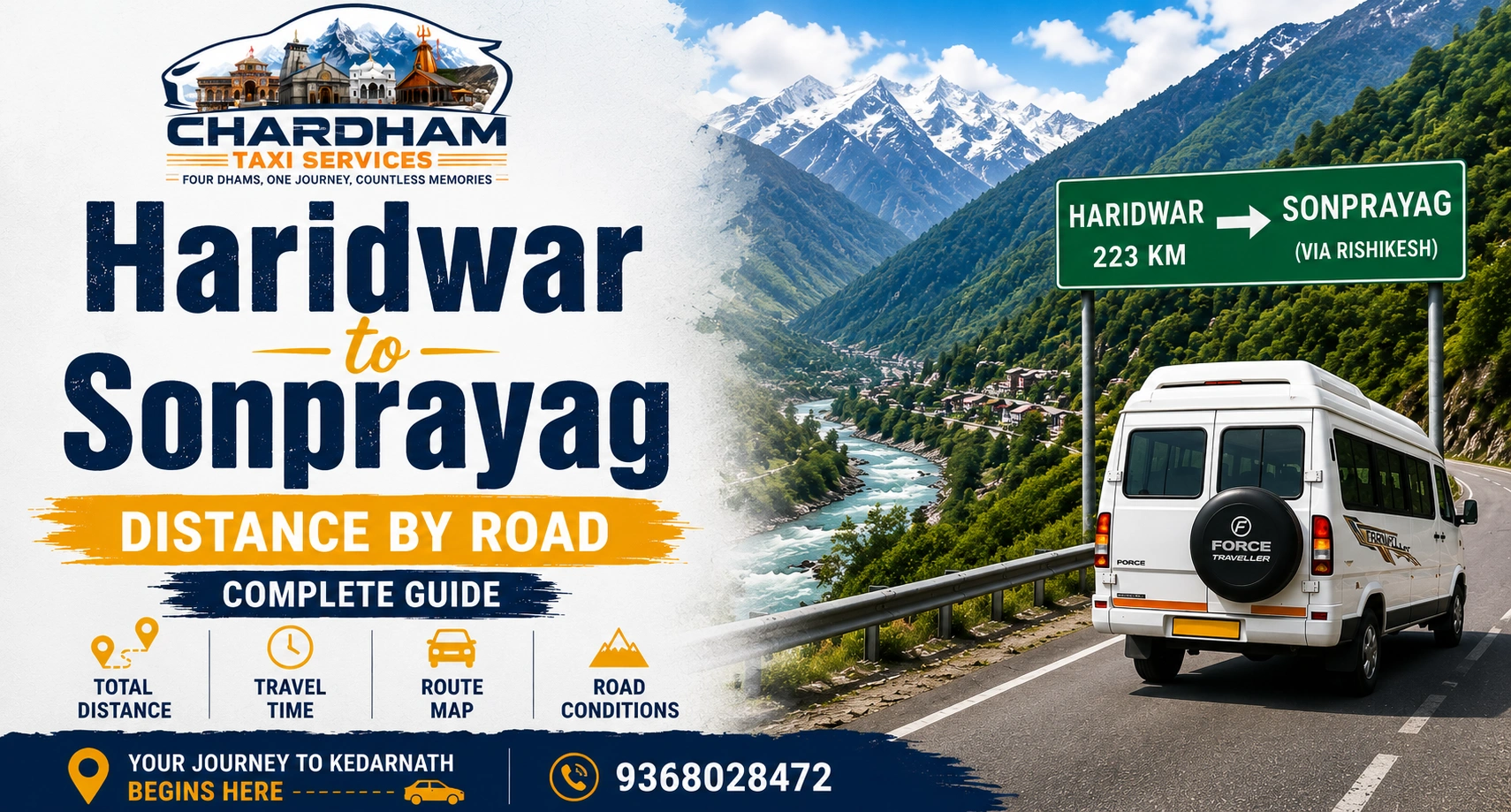
If you're heading to Kedarnath, Sonprayag is the checkpoint you can't skip. It's where the road ends and the final leg to Gaurikund — and from there, the trek or pony/palki route to Kedarnath — begins. Most pilgrims starting from Haridwar plan this as a single long travel day, or split it with an overnight stop at Rudraprayag or Guptkashi.
This guide covers the full Haridwar to Sonprayag journey: exact distance, the stage-by-stage route, travel time, taxi and bus fares, road conditions, and practical tips for a smoother yatra. Whether you're travelling by private cab, shared taxi, or bus, this should answer everything you need before booking.
|
📞
Call Now Speak directly with our team Call: 93680 28472 |
💬
WhatsApp Us Get fare & availability instantly WhatsApp Now |
🚖
Book Now Reserve your cab online Book a Ride |
Haridwar to Sonprayag Distance by Road
The road distance between Haridwar and Sonprayag is approximately 225 to 230 km. There's a single main route for this journey — it runs along the Alaknanda river valley through Rishikesh, Devprayag, Srinagar (Garhwal), and Rudraprayag before reaching Guptkashi and finally Sonprayag.
| Segment | Distance | Approx. Time |
|---|---|---|
| Haridwar → Rishikesh | ~24 km | 35–45 min |
| Rishikesh → Devprayag | ~70 km | 2–2.5 hrs |
| Devprayag → Srinagar (Garhwal) | ~34 km | 1–1.5 hrs |
| Srinagar → Rudraprayag | ~34 km | 1–1.5 hrs |
| Rudraprayag → Guptkashi | ~46 km | 1.5–2 hrs |
| Guptkashi → Sonprayag | ~29 km | 45 min–1 hr |
| Haridwar → Sonprayag (Total) | ~225–230 km | 8–9 hrs |
In practical terms, this is a full day of driving, not a quick trip. The road follows the river for most of the way, which keeps the gradient manageable but means constant curves. Road conditions are generally good on the main stretch, though sections near Rudraprayag and beyond can narrow, and monsoon months bring occasional landslide-related delays.
One thing worth keeping in mind: during peak Char Dham Yatra season (May–June and September–October), traffic congestion near Rudraprayag, Guptkashi, and the final approach to Sonprayag can add 1.5 to 2 hours to the total journey. Starting early from Haridwar — ideally by 5–6 AM — helps you reach Sonprayag before the evening bottleneck.
Route Breakdown: Haridwar to Sonprayag Stage by Stage
Haridwar to Rishikesh (~24 km)
A short, flat stretch along a well-maintained road. Most cabs cover this in under 45 minutes. This is also where many pilgrims make their first stop for breakfast before the long drive ahead.
Rishikesh to Devprayag (~70 km)
The road starts climbing gently here, tracing the Ganga and then the Alaknanda river. Devprayag itself is significant — it's the sacred confluence where the Bhagirathi and Alaknanda rivers meet to form the Ganga. Many travellers pause here briefly.
Devprayag to Srinagar (Garhwal) (~34 km)
A relatively straightforward hill stretch. Srinagar (not to be confused with Kashmir's Srinagar) is a mid-sized town with fuel stations, food options, and basic medical facilities — a sensible stop if needed.
Srinagar to Rudraprayag (~34 km)
Another river confluence town — Alaknanda meets Mandakini here. Rudraprayag is also where the road splits: one route continues toward Badrinath, and the other turns toward Kedarnath via Guptkashi. Make sure your driver takes the Kedarnath-bound road at this junction.
Rudraprayag to Guptkashi (~46 km)
This stretch follows the Mandakini river valley and is where the road starts to feel distinctly more mountainous. Guptkashi is a common overnight halt for pilgrims splitting the Haridwar-to-Sonprayag journey across two days.
Guptkashi to Sonprayag (~29 km)
The final stretch. The road narrows further as you approach Sonprayag, and this section sees the heaviest pilgrim traffic during peak yatra season. Sonprayag itself is where the Mandakini and Son Ganga rivers meet — hence the name.
Planning the full Haridwar to Sonprayag route?
Get an instant fare quote for your Kedarnath Yatra taxi.
Haridwar to Sonprayag Taxi Fare
Taxi fares for this route depend on vehicle type, whether it's a one-way or round trip, and the season. Here are realistic estimates:
| Vehicle Type | One-Way Fare (Approx.) | Round Trip (Approx.) |
|---|---|---|
| Sedan (Dzire / Etios) | ₹6,500 – ₹8,000 | ₹11,000 – ₹14,000 |
| Ertiga (MUV) | ₹8,000 – ₹9,500 | ₹13,500 – ₹17,000 |
| Innova Crysta (SUV) | ₹9,500 – ₹12,000 | ₹16,000 – ₹20,000 |
| Tempo Traveller (9–12 seater) | ₹14,000 – ₹18,000 | ₹24,000 – ₹30,000 |
Note: These are approximate ranges. Actual fares vary by operator, season, fuel prices, and vehicle availability. Peak Char Dham Yatra season (May–June) typically sees higher rates due to demand. Always confirm the final fare, toll charges, and driver allowance before departure.
For pilgrims travelling in a group, the Tempo Traveller or Innova options often work out more economical per person, and also reduce the number of stops needed compared to smaller vehicles. If your yatra plan extends beyond Kedarnath to the full Char Dham circuit, our Chardham taxi services can arrange the complete route in one booking rather than segment by segment.
Haridwar to Sonprayag Bus
State-run and private buses operate on this route, primarily during the Char Dham Yatra season (roughly April/May to October/November, weather permitting). GMOU (Garhwal Motor Owners Union) and Uttarakhand Roadways buses connect Haridwar to Rudraprayag, Guptkashi, and Sonprayag, though direct buses all the way to Sonprayag are less frequent than services terminating at Rudraprayag or Guptkashi.
Typical bus journey characteristics:
- Travel time: 10–12 hours, including stops — noticeably longer than private taxi due to multiple halts
- Fare: Approximately ₹400–₹700 depending on the bus type and operator
- Frequency: Higher during peak yatra months; limited or unavailable during the off-season when Kedarnath is closed
- Comfort: Basic seating, not ideal for elderly travellers or those with heavy luggage on a long mountain route
For most pilgrims — especially families, elderly travellers, or anyone travelling with yatra luggage — a private taxi remains the more practical and comfortable option for this specific route, given the length and the mountain roads involved.
Sonprayag: What to Know Before You Arrive
Sonprayag is not Kedarnath itself — it's the last point where private and hired vehicles are typically permitted before the route continues toward Gaurikund. Here's what matters practically:
- Vehicle restriction: Private vehicles usually need to park at Sonprayag, with travellers switching to shared shuttle taxis for the short stretch to Gaurikund (approximately 4–5 km). This is a traffic-management measure during peak season.
- Trek to Kedarnath: From Gaurikund, the trek to Kedarnath is approximately 16 km on foot, or via pony, palki, or helicopter service (subject to availability and weather).
- Registration requirement: Char Dham Yatra registration/biometric verification is mandatory for Kedarnath pilgrims. Requirements and the registration process can change year to year, so check the current process on the official Uttarakhand Char Dham Yatra portal before travelling.
- Basic facilities: Sonprayag has guesthouses, dhabas, and parking areas, making it a practical overnight base for pilgrims who want to start the Gaurikund–Kedarnath leg early the next morning.
- Seasonal closure: Kedarnath temple and the yatra route typically close around late October/November (Diwali period, weather-dependent) and reopen around April/May. Confirm current dates before planning travel outside the main season.
Need a cab for the full Kedarnath Yatra route?
We cover Haridwar to Sonprayag and the complete Char Dham circuit.
+91 93680 28472 | Available 7 days a week
Best Time to Travel from Haridwar to Sonprayag
May – June (Peak Season)
The busiest window for Kedarnath Yatra. Weather is favourable, but expect heavy traffic on the Rudraprayag–Guptkashi–Sonprayag stretch, especially on weekends. Book accommodation and transport well in advance.
July – August (Monsoon)
This is the most caution-heavy period. Landslide risk increases significantly on the hill sections of this route, particularly between Rudraprayag and Sonprayag. Road blockages are possible with limited notice. If your schedule is flexible, consider avoiding peak monsoon weeks.
September – October (Post-Monsoon)
Often considered one of the better windows — clearer skies, greener valleys, and typically less crowded than the May–June rush. The yatra season starts winding down by late October.
Winter (Closed Season)
Kedarnath and the Sonprayag–Gaurikund route are effectively closed to pilgrimage travel from around late autumn through early spring due to snow. Confirm current opening and closing dates before planning any winter travel on this route.
Travel Tips for the Haridwar to Sonprayag Journey
- Start very early: A 5–6 AM departure from Haridwar gives you the best chance of reaching Sonprayag before evening traffic builds near Guptkashi.
- Consider splitting the journey: An overnight halt at Rudraprayag or Guptkashi turns an exhausting single-day drive into a more comfortable two-day trip — especially useful for elderly travellers or families with children.
- Check road status before travel: During monsoon months, landslide advisories on this route change quickly. Your driver or local transport operators are usually the fastest source of current road status.
- Carry warm layers: Even in peak summer, temperatures drop noticeably as you climb past Guptkashi. Nights at Sonprayag can be quite cool.
- Complete yatra registration in advance: Char Dham registration is typically required before you can proceed beyond certain checkpoints. Complete this ahead of travel to avoid delays at Sonprayag.
- Fuel up before Rudraprayag: Fuel stations become less frequent on the final stretch toward Sonprayag. Top up in Rudraprayag or Guptkashi.
- Book your return transport in advance: During peak season, arranging a cab back from Sonprayag on short notice can be difficult. Confirm your return journey when booking the onward trip.
Combining This Route with the Full Char Dham Circuit
Sonprayag is typically one stop within a broader Char Dham Yatra itinerary that also covers Yamunotri, Gangotri, and Badrinath. If you're planning the complete circuit rather than just the Kedarnath leg, a single dedicated taxi booking for the entire yatra is usually more efficient than arranging transport city by city.
Our Chardham taxi services team can plan the full route — Haridwar to Sonprayag, onward to Badrinath, and the western Char Dham circuit — with experienced hill drivers who know the seasonal road conditions and pilgrim traffic patterns well.
Frequently Asked Questions: Haridwar to Sonprayag
Final Thoughts: Planning Your Haridwar to Sonprayag Journey
The Haridwar to Sonprayag distance — roughly 225 to 230 km — represents one of the longer single-day drives in the Char Dham Yatra circuit, but it's also one of the most scenic, tracing the Ganga and Alaknanda–Mandakini valleys through several sacred confluence towns. Whether you drive it in a single long day or split it with an overnight halt at Rudraprayag or Guptkashi, starting early and checking road conditions in advance will make the trip considerably smoother.
If your plans extend beyond Kedarnath to the full Char Dham circuit, our Chardham taxi services can arrange the complete route with experienced drivers who know these mountain roads well.
Book Your Haridwar to Sonprayag Taxi
Sedan · Ertiga · Innova · Tempo Traveller | One-way & Round Trip
📱 +91 93680 28472 · Available 7 days a week