
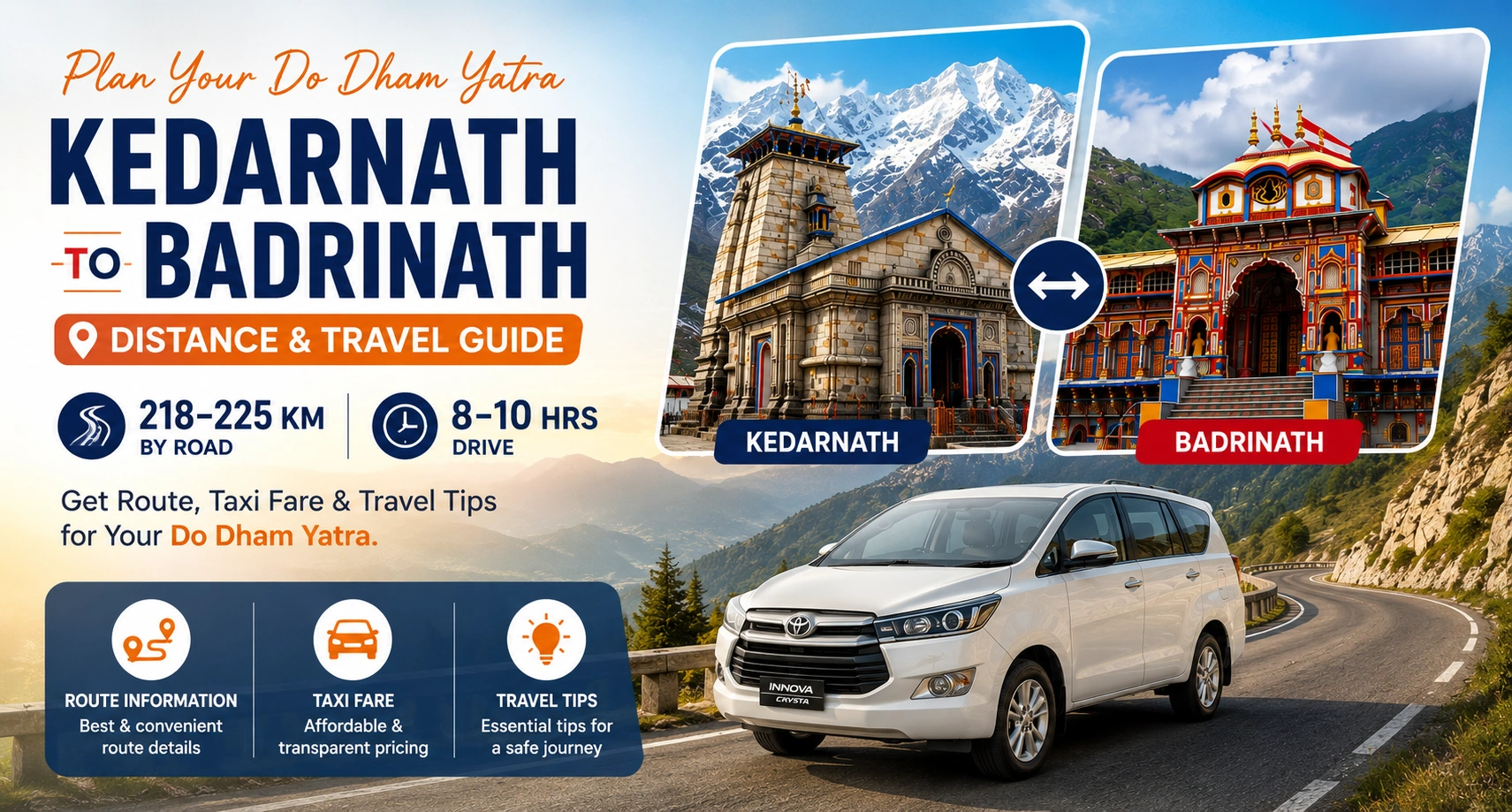
The Kedarnath to Badrinath distance by road is approximately 218–225 km, measured from Sonprayag / Gaurikund, the last motorable point near Kedarnath. The drive takes around 8 to 10 hours via Guptkashi, Rudraprayag, Chamoli, and Joshimath. Since Kedarnath Temple itself is not connected by road, pilgrims must first complete a 16 km trek down to Gaurikund before the road journey to Badrinath begins. As the crow flies, the two shrines are only about 40 km apart — the Himalayan terrain is what stretches the actual travel distance so significantly.
Kedarnath to Badrinath — Understanding the Journey
Kedarnath and Badrinath are two of the four sacred shrines of the Char Dham Yatra, and together with Gangotri and Yamunotri, they form one of Hinduism's most revered pilgrimage circuits. Kedarnath, dedicated to Lord Shiva, sits at 3,583 metres in the Rudraprayag district. Badrinath, dedicated to Lord Vishnu, sits at 3,133 metres in Chamoli district, on the banks of the Alaknanda river.
On a map, the two temples look deceptively close — barely 40 km apart in a straight line. But the Himalayas don't allow straight lines. The road distance between them stretches to over 200 km because the route has to wind around river valleys, climb through mountain passes, and skirt terrain that simply cannot be crossed directly. Booking a reliable char dham taxi service makes a real difference on a route like this. This guide breaks down exactly how far it is, how long it takes, and what your travel options actually look like.
One thing to understand early: there is no direct road connecting Kedarnath Temple to Badrinath Temple. Kedarnath is only reachable by a 16 km trek (or pony/palanquin/helicopter) from Gaurikund, the last point where vehicles can go. So any "Kedarnath to Badrinath" road journey technically starts from Gaurikund or Sonprayag, not from the temple steps themselves.
Kedarnath to Badrinath Distance by Road
The distance between Kedarnath and Badrinath by road is approximately 218–225 km, and the journey typically takes 8 to 10 hours under normal conditions. This figure is measured from Sonprayag or Gaurikund — the road-accessible base for Kedarnath — since Kedarnath Temple itself sits beyond a motorable road.
| Leg of Journey | Distance | Time | Mode |
|---|---|---|---|
| Kedarnath Temple → Gaurikund | 16 km | 6–8 hrs | Trek / Pony / Palanquin |
| Gaurikund → Sonprayag | 5 km | 15–20 min | Taxi / Shared jeep |
| Sonprayag → Badrinath (by road) | ~218–225 km | 8–10 hrs | Taxi / Bus |
| Total (Kedarnath to Badrinath) | ~240 km | 14–18 hrs (incl. trek) | Combined |
| Straight-line (aerial) distance | ~40–41 km | — | By helicopter (with transfer) |
📍 Note: Distances vary slightly (218 km to 240 km) depending on the exact starting point used — some guides measure from Sonprayag, others from Gaurikund, and some include the 16 km trek in the total. Road conditions, landslide-prone stretches, and seasonal diversions can also add time. Always check local updates before departure.
Complete Route: Kedarnath to Badrinath, Stage by Stage
The standard route follows: Kedarnath → Gaurikund → Sonprayag → Guptkashi → Rudraprayag → Karnaprayag → Chamoli → Pipalkoti → Joshimath → Badrinath. Here's how each stage breaks down:
-
1Kedarnath Temple → Gaurikund 16 km · 6–8 hrs (downhill trek) · On foot, pony, palanquin, or helicopter
-
2Gaurikund → Sonprayag ~5 km · 15–20 min · Local taxi or shared jeep
-
3Sonprayag → Guptkashi ~30 km · ~1 hr · Mountain road, moderate traffic
-
4Guptkashi → Rudraprayag ~45 km · ~1.5 hrs · Sacred confluence of Alaknanda and Mandakini rivers
-
5Rudraprayag → Karnaprayag → Chamoli ~65 km · ~2 hrs · Scenic Alaknanda valley drive
-
6Chamoli → Pipalkoti → Joshimath ~65 km · ~2 hrs · Winding hill road, base for Auli
-
7Joshimath → Badrinath ~45 km · 1.5–2 hrs · Final climb via NH-7, Alaknanda-Dhauliganga confluence en route
💡 Alternate shorter route: Some travelers use the Kedarnath → Ukhimath → Chopta → Gopeshwar → Badrinath route, which measures around 207 km — slightly shorter than the Rudraprayag route. This path also lets you stop at Tungnath, one of the highest Shiva temples in the world, and Chopta, often called "Mini Switzerland." It's a good option if you have time for an extra scenic detour.
Transport Options from Kedarnath to Badrinath
By Road — Taxi (Recommended)
A private taxi is by far the most practical way to cover the Kedarnath to Badrinath road distance. A dependable char dham taxi service gives you flexibility to stop at Rudraprayag, Karnaprayag, or Joshimath, adjust pace based on how you're feeling at altitude, and avoid the uncertainty of shared transport schedules. Most pilgrims split the journey across two days with an overnight halt at Guptkashi, Rudraprayag, or Joshimath, rather than attempting the full 8–10 hour drive in one stretch after an already exhausting trek down from Kedarnath.
By Road — Bus
There is no single direct bus that runs from Kedarnath temple to Badrinath temple — this isn't possible since Kedarnath has no road access. However, Uttarakhand Roadways buses and private operators run services from Sonprayag and Rudraprayag toward Badrinath. Bus travel is budget-friendly but involves more waiting time, potential transfers, and less flexibility for stops, especially during peak yatra season when buses run at full capacity.
By Helicopter
For pilgrims short on time or concerned about the physical strain of the trek and long drive, a helicopter is the fastest option. Typically this involves a Kedarnath-to-Phata or Kedarnath-to-Guptkashi helicopter transfer, followed by a separate helicopter service onward to Badrinath. Total travel time, including waiting periods, is usually around 2 to 3 hours — dramatically shorter than the road-and-trek combination, though considerably more expensive and subject to weather-based delays and seasonal availability.
By Train
There is no railway station at either Kedarnath or Badrinath — the terrain simply doesn't support it. The nearest railway station to both destinations is Rishikesh (with Haridwar and Dehradun also serving as common rail entry points). If you're asking about "Kedarnath to Badrinath distance by train," the honest answer is that train travel only gets you to Rishikesh or Haridwar; the rest of the journey, including both shrines, has to be completed by road, trek, or helicopter.
| Mode | Approx. Time | Best For |
|---|---|---|
| Private Taxi (road) | 8–10 hrs (post-trek) | Flexibility, families, comfort |
| Bus (Sonprayag → Badrinath) | 9–11 hrs | Budget travelers |
| Helicopter (both legs) | 2–3 hrs | Time-constrained, elderly, VIP |
| Train | Not applicable | Only reaches Rishikesh/Haridwar |
Taxi Fare from Kedarnath to Badrinath
Taxi fares for this route depend on vehicle type, season, and whether you're booking one-way or as part of a broader Char Dham/Do Dham package. Here's a general fare guide from Sonprayag to Badrinath:
| Vehicle Type | One-Way Fare (approx.) | Seating |
|---|---|---|
| Sedan (Dzire, Etios) | ₹7,000 – ₹10,000 | 4 passengers |
| Ertiga / XL6 | ₹9,000 – ₹12,000 | 6 passengers |
| Innova Crysta | ₹11,000 – ₹15,000 | 7 passengers |
| Tempo Traveller | ₹16,000 – ₹22,000 | 10–12 passengers |
Fares typically rise during peak Char Dham Yatra months (May–June) due to high demand and limited vehicle availability. Booking in advance with a trusted char dham taxi service — especially if you need a driver experienced with high-altitude mountain roads — is strongly recommended over arranging transport last-minute at Sonprayag.
Planning Kedarnath to Badrinath?
We arrange private taxis for the full Do Dham route — Kedarnath, Badrinath, and everything in between. Local drivers, fixed fares, no last-minute surprises.
Best Time to Travel Kedarnath to Badrinath
The Char Dham Yatra season runs roughly from May to November, with both temples closing for winter as snow makes the high-altitude routes impassable. Within this window, two periods stand out as ideal:
- May to June: Pleasant weather, clear mountain views, but also the busiest period with the heaviest pilgrim traffic. Book taxis and accommodation well in advance.
- September to October: Post-monsoon clarity, thinner crowds, comfortable daytime temperatures. Many experienced travelers consider this the better window for road travel specifically, since monsoon-related landslide risk has passed.
The monsoon months (July–August) bring a higher risk of landslides along this route, particularly on the Rudraprayag–Karnaprayag stretch. If you must travel during monsoon, build extra buffer days into your itinerary and stay updated on road advisories.
Practical Travel Tips for This Route
- Don't attempt the full journey in one day. Completing the Kedarnath trek and then immediately driving 8–10 hours to Badrinath is physically exhausting. Most pilgrims split this into 2 days with an overnight stop at Guptkashi, Rudraprayag, or Joshimath.
- Watch for altitude effects. Both Kedarnath (3,583 m) and Badrinath (3,133 m) sit at high altitude. If you or a family member felt breathless at Kedarnath, drink extra water during the drive and eat light before the climb to Badrinath.
- Start early. Mountain roads are safer to navigate in daylight, and an early start helps you reach your overnight stop or Badrinath itself before evening aarti.
- Book your taxi in advance during peak season. May–June sees the highest demand for vehicles on this route; last-minute bookings at Sonprayag can mean higher prices or long waits.
- Check road conditions before departure. This route passes through landslide-prone sections, especially during and just after monsoon. Local drivers who know the route are worth the investment.
- Consider the Chopta route for extra sightseeing. If your schedule allows, the Ukhimath–Chopta–Gopeshwar route offers a chance to visit Tungnath temple along the way.
- Carry basic medication and warm layers. Temperatures swing significantly between the plains-facing stretches and the high-altitude points near both temples.
Frequently Asked Questions — Kedarnath to Badrinath Distance
-
The Kedarnath to Badrinath distance by road is approximately 218–225 km, measured from Sonprayag or Gaurikund — the last motorable points near Kedarnath. The drive takes around 8 to 10 hours via Guptkashi, Rudraprayag, Chamoli, and Joshimath.
-
Including the 16 km trek from Kedarnath Temple down to Gaurikund, the total distance between Kedarnath and Badrinath comes to approximately 240 km. This combines the trek (16 km) with the road journey (roughly 218–225 km) from Sonprayag to Badrinath.
-
No. Kedarnath Temple is not connected by any motorable road — it's reachable only via a 16 km trek, pony, palanquin, or helicopter from Gaurikund. Any road journey toward Badrinath begins from Gaurikund or Sonprayag, not from the temple itself.
-
The road journey typically takes 8 to 10 hours under normal conditions. Including the 16 km trek down from Kedarnath (which takes 6–8 hours), the full journey from Kedarnath Temple to Badrinath can take anywhere from 14 to 18 hours total, which is why most pilgrims split it across two days.
-
The taxi distance from Sonprayag to Badrinath is around 218–225 km. Fares range from approximately ₹7,000–₹10,000 for a Sedan, ₹9,000–₹12,000 for an Ertiga, ₹11,000–₹15,000 for an Innova Crysta, and ₹16,000–₹22,000 for a Tempo Traveller, one-way. Prices rise during peak season (May–June).
-
There is no direct bus from Kedarnath temple itself, since Kedarnath has no road access. However, buses and shared vehicles are available from Sonprayag and Rudraprayag toward Badrinath. Bus travel is more economical but comes with less flexibility and longer waiting times, especially during peak yatra season.
-
Neither Kedarnath nor Badrinath has a railway station — the mountainous terrain doesn't support rail access. The nearest railway station to both is Rishikesh (Haridwar and Dehradun are also common entry points). From there, the remainder of the journey to both shrines must be completed by road, trek, or helicopter.
-
As the crow flies, Kedarnath and Badrinath are only about 40–41 km apart. The large gap between this aerial distance and the 218–225 km road distance is due to the mountainous terrain — the road has to wind around river valleys and high passes that a straight line simply cuts through.
-
The standard route is: Gaurikund → Sonprayag → Guptkashi → Rudraprayag → Karnaprayag → Chamoli → Pipalkoti → Joshimath → Badrinath. An alternate, slightly shorter route (around 207 km) goes via Ukhimath, Chopta, and Gopeshwar, which also allows a stop at Tungnath Temple.
-
Yes, though there's typically no single direct helicopter service. Most pilgrims take a helicopter from Kedarnath to Phata or Guptkashi, then a separate helicopter onward to Badrinath. Total travel time, including waiting periods, is usually 2 to 3 hours — much faster than road travel, though costlier and weather-dependent.
-
Splitting the journey across two days is strongly recommended. Completing the 16 km trek down from Kedarnath and then immediately driving 8–10 hours to Badrinath in a single day is physically demanding, especially at high altitude. An overnight halt at Guptkashi, Rudraprayag, or Joshimath makes the journey far more comfortable.
Book Your Kedarnath to Badrinath Taxi Today
Experienced mountain drivers, fixed transparent fares, and full support across your Do Dham or Char Dham Yatra. One call and it's sorted.


[…] since it removes the planning work of sequencing halts, permits, and drop points yourself. Our Kedarnath to Badrinath distance guide covers this combined journey in full […]
[…] to Kedarnath Distance → Haridwar to Sonprayag Distance → Haridwar to Sonprayag Taxi Fare → Kedarnath to Badrinath Distance → Haridwar to Badrinath Distance → Places to See During Chardham Tour → Char Dham Yatra Route Map […]
[…] is reached by a separate trek from Gaurikund. If you are combining both shrines, the guide on the Kedarnath to Badrinath distance and the page about the Kedarnath temple will help. For the Kedarnath side, see the Haridwar to […]